
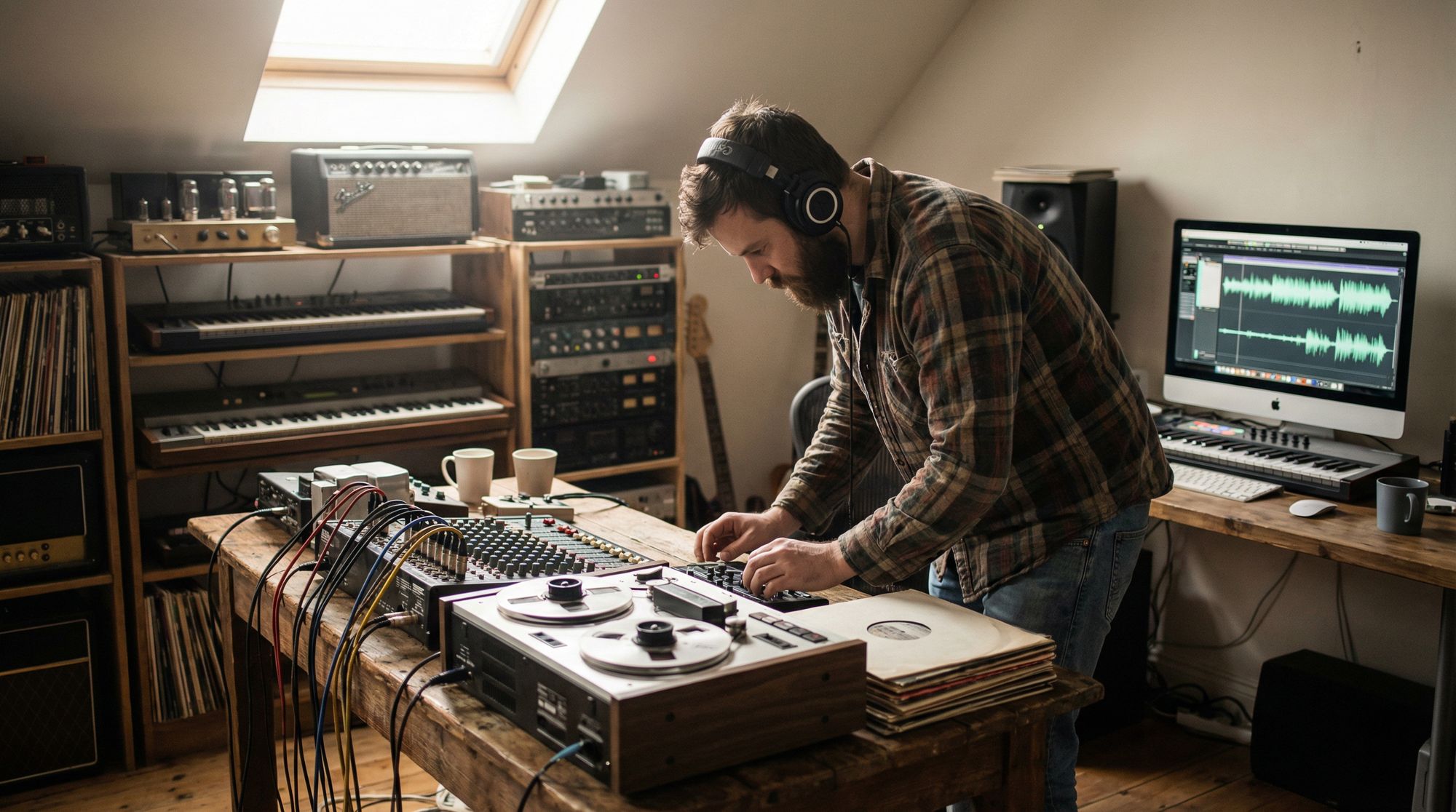
The music industry stands at an inflection point where AI music production tools tools are fundamentally reshaping how songs come to life. What once required thousands of dollars in studio time, specialized equipment, and weeks of post-production can now be achieved in hours using sophisticated algorithms and neural networks. This isn't theoretical disruption—87% of music producers already use AI tools in their creative workflows, signaling a seismic shift in how the industry operates.
The economics tell a compelling story. Traditional production routes—studio rental, session musicians, mixing engineers, mastering specialists, and marketing campaigns—can easily exceed $20,000 per track for professional-grade releases. Meanwhile, AI mixing mastering tools and generative platforms promise similar quality outputs at a fraction of the cost. But this efficiency comes with hidden tradeoffs that extend beyond dollar amounts.
Energy consumption adds another dimension to the comparison. While home studios consume relatively predictable power loads, the AI server power required for cloud-based music generation platforms operates at data center scale. Each AI-generated track draws computational resources equivalent to hundreds of search queries, raising questions about long-term sustainability that traditional methods never confronted.
As AI music production tools changess accelerates, artists and producers need clear-eyed analysis of both approaches. The following sections break down actual costs, energy metrics, workflow implications, and quality considerations to help you navigate this evolving landscape. Whether you're exploring AI-powered music creation or defending traditional production values, understanding these comparative economics is essential for making informed creative decisions in 2025 and beyond.
Traditional music production follows a multi-stage workflow that's been the industry standard for decades. It typically begins with pre-production planning, moves through recording sessions in professional studios, then advances to mixing and mastering before finally reaching the marketing phase. Each stage requires specialized equipment, trained professionals, and significant time investment.
The recording phase alone demands substantial resources. Professional studios consume considerable studio electricity running analog consoles, outboard gear, climate control systems, and high-powered monitors for extended sessions. According to industry analysis, traditional production requires coordinating multiple specialists—recording engineers, session musicians, mixing engineers, and mastering engineers—each commanding premium rates.
Financial costs compound quickly. Studio time averages $50-$200 per hour, with full production budgets for independent artists ranging from $5,000 to $50,000 per song. Mixing can add another $300-$1,500, while professional mastering typically costs $50-$200 per track. Marketing expenses—from promotional materials to distribution—often match or exceed production costs.
This reality explains why many emerging artists increasingly choose AI over studios for initial production stages. The traditional model's resource demands create significant barriers to entry, particularly for independent musicians working within tight budgets. While this approach delivers proven results and tangible creative collaboration, the cumulative investment in time, money, and energy presents practical limitations that newer technologies aim to address.
AI vs traditional music production methods production methods represent fundamentally different approaches to creating and finishing tracks. Where traditional workflows require manual intervention at every stage, music production automation now handles tasks ranging from drum programming to final mastering with minimal human input.
The adoption rate is staggering—87% of producers already use AI tools in their creative process, according to recent industry research. These tools span the entire production chain: algorithmic composition assistants, automated mixing plugins, intelligent mastering platforms like LANDR vs Waves mastering services (which blend AI efficiency with traditional processing quality), and even AI-powered marketing distribution.
The technology operates on machine learning models trained on millions of commercial tracks, enabling software to recognize patterns in frequency balance, dynamic range, and stereo imaging. This allows AI systems to make production decisions that historically required years of engineering experience.
However, the AI impact on music and art extends beyond convenience. While automation dramatically reduces both time and financial barriers to entry, it also raises questions about creative homogenization, the role of human intuition in mixing decisions, and whether technical accessibility might dilute the craft itself. The shift isn't simply about replacing humans with algorithms—it's about redefining what the production process means in practice.
Music production costs represent one of the most dramatic differences between traditional and AI-assisted workflows. A traditional single-track production can run anywhere from $2,000 to $10,000+ when you factor in studio time ($50-$500/hour), mixing ($300-$1,500), mastering ($150-$500), and session musicians. In contrast, AI-powered tools can reduce these costs by up to 70%, according to recent industry analysis.
into their workflows, using them for specific tasks like drum programming, vocal tuning, and reference mixing while maintaining human oversight for creative decisions.
However, when evaluating
The environmental footprint of AI music generation systems versus traditional production methods reveals surprising contrasts that extend well beyond simple energy calculations. Traditional studios require constant climate control, multiple power-hungry workstations, and physical transportation of artists and equipment—each session consuming resources whether anything gets recorded or not.
In contrast, low-cost music creation through AI platforms operates on shared cloud infrastructure that's optimized for efficiency at scale. According to DataArt, AI music production tools systems can process thousands of variations simultaneously on the same computational resources traditional workflows would need for a single iteration.
However, the environmental equation isn't entirely one-sided. Large language models and generative AI systems require significant energy for training—though once trained, inference costs drop dramatically. The key distinction: traditional studios waste energy continuously maintaining infrastructure, while AI music production tools savings concentrate energy use during active creation, not idle time.
Physical media production and distribution add another layer to traditional methods' environmental impact. Manufacturing CDs, vinyl, and promotional materials generates waste that AI-distributed music avoids entirely. The carbon footprint of shipping physical products to retailers dwarfs the minimal energy needed to stream or download digital files created through AI platforms.
What typically happens is that studios running 24/7 consume resources regardless of productivity, whereas AI tools scale their environmental impact directly with actual use—making them inherently more efficient for intermittent creators and independent artists.
The energy footprint of traditional music production methods extends far beyond the studio walls. A conventional recording session requires climate-controlled facilities running continuously, multiple high-powered computers processing audio, and outboard gear consuming electricity for days or weeks. The energy costs of traditional music mixing accumulate quickly when producers factor in HVAC systems maintaining optimal temperatures for equipment and musicians alike.
Music mixing costs traditionally include substantial energy overhead—professional studios often run equipment 24/7 to avoid power cycling that can degrade sensitive electronics. One mixing session might consume 50-100 kWh over several days, not counting the energy required for file transfers, backups, and client revisions.
AI-assisted workflows flip this equation entirely. Cloud-based AI tools process audio using shared server infrastructure that's optimized for efficiency at scale. What typically happens is that cost creating songs AI vs traditional methods shows dramatic energy savings—AI can generate and mix arrangements in minutes using a fraction of the power.
However, there's a caveat: AI's environmental advantage diminishes when creators produce more content simply because it's cheaper. The music video production costs and marketing efforts that follow still require traditional energy inputs, regardless of how the audio was created. The real sustainability gains come from strategic AI use, not just volume production.
Let's examine how different creators navigate the shift from traditional to AI-assisted workflows. A bedroom producer tackling music mastering costs might spend $150-300 per track with a professional engineer, but 87% of producers now use AI tools to handle initial mastering passes for under $30 monthly through subscription services. One common pattern is running AI mastering first, then selectively hiring engineers only for flagship releases—cutting annual mastering budgets by 60-70%.
For content creators needing background music, the traditional route meant either licensing tracks at $50-200 each or hiring composers at $500+ per custom piece. Today's scenario typically involves AI platforms generating music in minutes. A YouTube channel producing weekly videos saves roughly $2,400 annually while maintaining consistent quality.
The energy expenses old-fashioned vs AI calculation becomes tangible in podcast production. A traditional three-hour studio session consumes around 15 kWh between climate control, equipment, and post-production workstations. An AI-enhanced workflow—recording at home with AI noise removal and automated editing—drops this to approximately 2-3 kWh. For creators publishing bi-weekly episodes, that's 600+ kWh saved annually, translating to $75-120 in energy costs while eliminating studio rental fees of $3,000-6,000 per year.
However, these savings assume basic technical literacy and willingness to iterate with AI tools rather than expecting immediate perfection.
While AI tools slash musician hiring costs and production expenses, they're not a silver bullet. The technology stumbles with nuanced emotional performances—that subtle breath before a vocal phrase or the micro-timing variations that give tracks their human groove. A study tracking AI adoption found producers still spend significant time correcting AI-generated arrangements that lack musical context.
ROI music production calculations must account for hidden costs. You'll need time learning new platforms, subscription fees stacking up ($50-200/month across multiple tools), and potential re-work when AI outputs miss the mark. Many creators discover that hybrid workflows—using AI for initial ideas but human talent for final touches—deliver better results than full automation.
The quality gap matters for commercial work. When calculating traditional vs AI video costs, remember that clients paying premium rates expect polish that current AI struggles to deliver consistently. Background music for social content? AI works great. Lead vocals for a sync placement? You'll probably still need session singers.
The shift from traditional to AI-assisted music production represents a fundamental recalibration of how costs accumulate. Traditional workflows demand studio rental fees ranging from $50-$500 per hour, engineer compensation, and multiple revision cycles that stretch budgets thin. AI reduces music costs by compressing timelines—what once required weeks of studio time now happens in hours at your desk.
However, the human-crafted vs AI music debate isn't purely financial. Traditional production delivers irreplaceable emotional nuance and artistic interpretation, while AI excels at speed, consistency, and accessibility for creators without deep pockets. A recent industry analysis confirms that 87% of producers already integrate AI tools, suggesting the future lies in hybrid approaches rather than wholesale replacement.
The practical reality? AI slashes upfront production costs by 60-80%, but traditional methods still dominate when projects demand complex emotional performances or established artist credibility. Smart creators evaluate each project individually—using AI for demos, concept tracks, and rapid iteration, while reserving traditional production for releases where human touch justifies the premium investment.
The conversation around music production energy consumption rarely makes headlines, but it's reshaping how the industry evaluates costs. Traditional studios gulp electricity through HVAC systems maintaining precise acoustics, power-hungry analog gear, and computing clusters for processing. A single 12-hour recording session in a professional facility can consume 50-100 kWh – equivalent to running a household for several days.
AI-based production flips this equation. Cloud-based tools handle AI mastering a song using distributed server farms optimized for efficiency at scale. While data centers certainly consume energy, the per-track cost diminishes dramatically when infrastructure serves thousands of simultaneous users. What once required dedicated physical space and equipment now happens on a laptop drawing 65 watts.
However, traditional music production methods expenses included tangible assets musicians could resell – vintage compressors, microphones, mixing consoles. AI tools represent subscription costs that evaporate when payments stop, leaving no residual value. The environmental ledger becomes murkier when factoring in e-waste from constantly upgrading hardware to run newer AI models versus maintaining analog equipment for decades.
The real breakthrough isn't just carbon reduction – it's democratization. Bedroom producers in countries with unreliable power grids can now compete with major-label productions, provided they've got internet access. That geographic leveling matters as much as the kilowatt hours saved. The energy conversation ultimately circles back to access, efficiency, and whether sustainability metrics should weigh creative output against environmental cost.